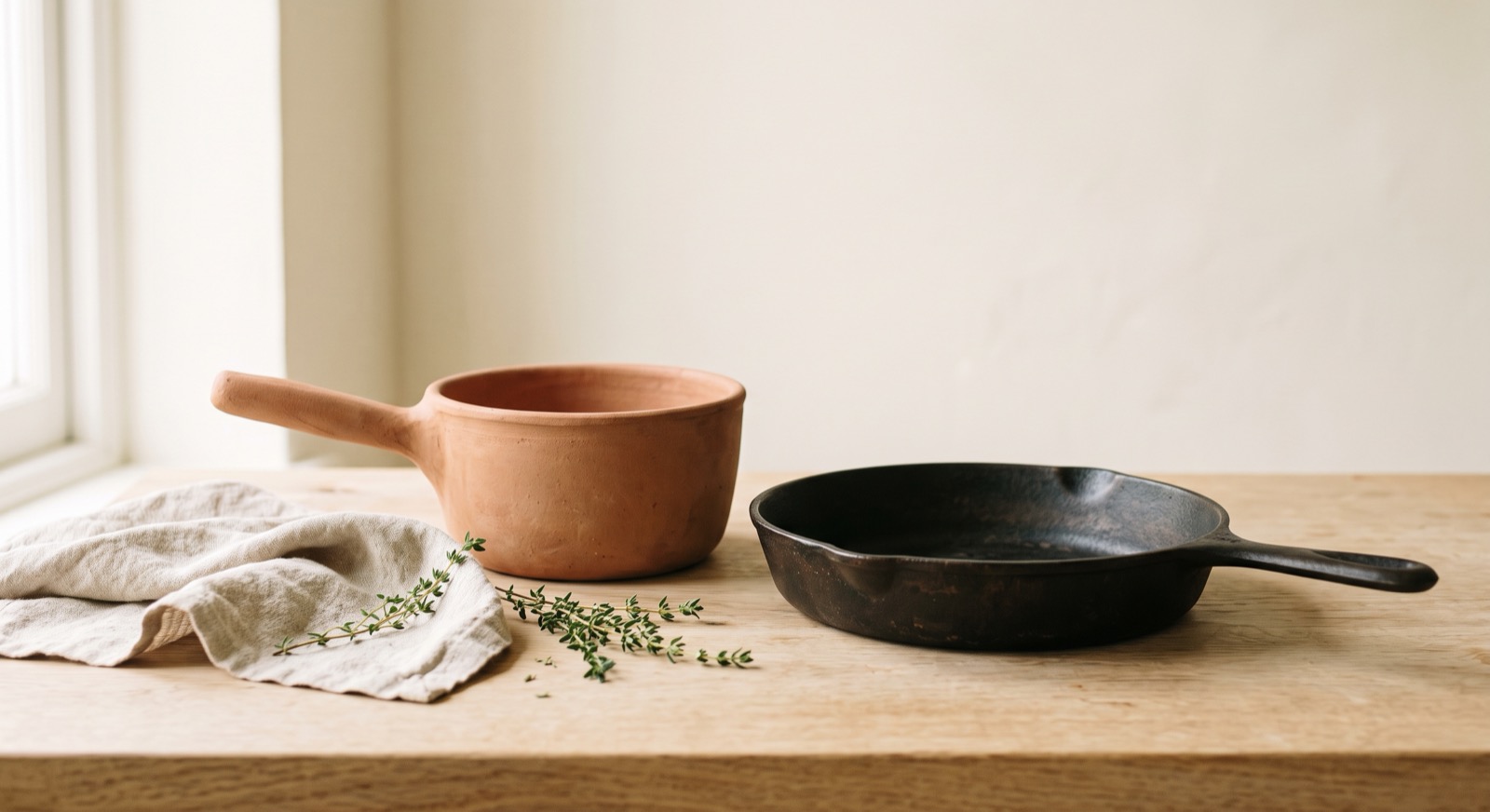
Which pans work on induction? How to check in ten seconds
Pots & Pretties
A pan works on induction if its base is magnetic. Hold a fridge magnet against the underside: if it grips firmly, the pan will heat on an induction hob. If it falls off or barely holds, it will not. Cast iron, enamelled steel and most stainless steel pans with a magnetic base work; plain aluminium, copper, glass and ceramic do not.
How does induction cooking work?
Beneath the glass of an induction hob sits a coil that creates an alternating magnetic field. That field induces an electric current in a base made of magnetic metal, and the base heats up itself. The glass only gets warm because a hot pan is standing on it. That is why the base has to be magnetic: without iron in it, nothing happens.
Which materials work on induction?
| Material | Works on induction? | Good to know |
|---|---|---|
| Cast iron | Yes | Heats slowly and holds heat for a long time. Heavy: lift it rather than slide it. |
| Enamelled cast iron and steel | Yes | The iron or steel under the enamel does the work. |
| Carbon steel | Yes | Common for woks and crêpe pans. |
| Stainless steel | Usually | Depends on the alloy. Pans with an encapsulated or multi-layer base, such as 3-ply, usually have a magnetic outer layer. Do the magnet test. |
| Aluminium | Only with an induction base | Plain aluminium is not magnetic. Many aluminium pans have a steel plate pressed into the base. |
| Copper | Only with an induction base | Copper conducts heat superbly but is not magnetic. |
| Glass, ceramic and earthenware | No | Use them in the oven. An adapter plate works, but cooks more slowly and less efficiently. |
How do you test whether a pan is suitable?
- Take an ordinary fridge magnet.
- Hold it flat against the centre of the base, on the outside.
- If it grips firmly, the pan works on induction. If it lets go or slides off, it does not.
- Check the packaging or the underside of the pan for the induction symbol, a coil or zigzag line: it means the manufacturer rates the pan for induction.
Does the magnet only just hold? Then the base is weakly magnetic. The pan may heat slowly or unevenly, or the hob may not detect it.
What should you look for in the base?
- Flat: a base that bulges or dips picks up the magnetic field less well and heats unevenly. Lay a ruler across it to check.
- Diameter: choose a pan whose magnetic base is roughly the size of the cooking zone. The hob may not detect a pan that is too small; on many hobs the minimum lies between 10 and 12 cm, and the manual gives the exact figure.
- Humming is normal: a soft hum or ticking at a high setting comes from vibration in the base, especially in multi-layer bases. It says nothing about the quality of the pan.
Tips to keep pans and hob in good shape
- Do not heat an empty pan on the highest setting. Induction is fast, and a non-stick coating can overheat within moments.
- Lift heavy cast iron pans instead of sliding them across the glass, to avoid scratches.
Induction pans in our range
In Pots & Pans you will find frying pans, stockpots and woks. Looking for a particular material? Browse cast iron, enamelled steel, 3-ply or stainless steel. Not sure about a pan without the induction symbol? Send your question to info@potsandpretties.com. Cooking with cast iron? Read how to care for a cast iron pan.
Author
Pots & Pretties
About UsCategory
Cookware
Publication Date
September 12, 2026
yesterday
Related Articles
CookwareHow to care for a cast iron pan: seasoning, cleaning and removing rust
Rinse cast iron with hot water, dry it straight away on the hob and rub in a thin film of oil. Here is how to season it, clean it and deal with rust.
Read More Decoration
Unlock Your Dream Home: 12 Essential Decor Tips for a Stunning Home
Unlock your dream home with our top 12 essential home decoration tips for 2025, covering sustainable choices, bold colors, multifunctional designs, and affordable ideas to create a stylish and personal space.
Read More Kitchen Decor
Unlock Your Dream Kitchen: 2025's Top Decor Trends & Styling Secrets
Unlock your dream kitchen with 2025's top decor trends and styling secrets, from warm minimalism and statement stone to smart storage and sculptural lighting!
Read More