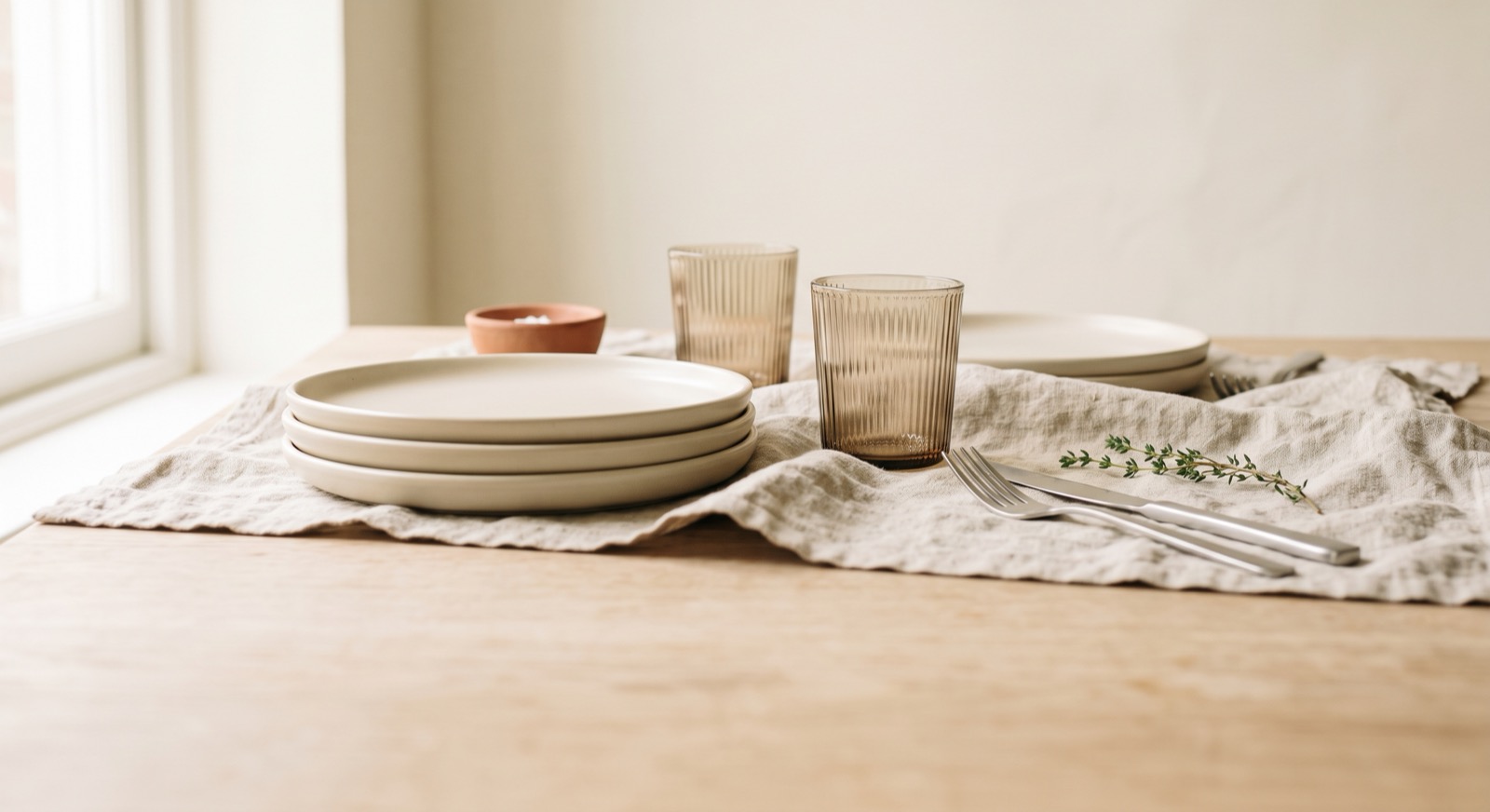
Porcelain, stoneware or earthenware? How to choose dinnerware
Melih Ozcan
Choose porcelain for dinnerware you use every day and want to keep for years: it is fired hottest, absorbs almost no water and resists chipping best for its weight. Stoneware is heavier and more rustic, and nearly as tough. Earthenware is the most porous and chips most easily, so it suits serving and decoration better than daily plates. Opal glass and melamine are the lightest and hardest to break.
What is the difference between porcelain, stoneware and earthenware?
All three are clay fired in a kiln. The difference is the clay and the temperature. The hotter the firing, the more the clay fuses into a glassy, dense body that takes up less water and is harder to chip.
| Material | Firing | Weight and feel | Chips | Best for |
|---|---|---|---|---|
| Porcelain | Hottest, roughly 1250 to 1400 °C | Thin, smooth, often slightly translucent | Least | Everyday plates, bowls and cups |
| Stoneware | Roughly 1200 to 1300 °C | Thicker and heavier, often a matt or speckled glaze | Little | Everyday use with a rustic look, oven dishes |
| Earthenware | Lowest, roughly 1000 to 1150 °C | Thick, porous under the glaze | Most | Serving, decoration, occasional use |
| Opal glass | Tempered glass | Light, white, smooth | Rarely, but can shatter when hit hard | Families, canteens, daily use |
| Melamine | Plastic | Very light, unbreakable in normal use | No | Picnic, garden, children |
Can dinnerware go in the dishwasher?
Porcelain, stoneware, opal glass and melamine usually can. Check the underside of a plate or the product page for the symbol. Two exceptions: dinnerware with a gold or platinum rim or hand-painted decoration keeps its decoration longer when washed by hand, and earthenware with a chip should not go in at all, because water gets into the porous body.
Can dinnerware go in the microwave?
Plain porcelain, stoneware and opal glass are usually microwave safe. Never put anything with a metal rim or metallic decoration in a microwave: it sparks. Melamine is not suitable for the microwave. When in doubt, follow the symbol on the product.
Can you put plates or bowls in the oven?
Only when the manufacturer says so. Ovenware is made to cope with the heat; ordinary plates are not always. Never move a dish straight from the fridge into a hot oven, or from the oven onto a cold wet surface: a sudden change in temperature can crack ceramic and glass.
How much dinnerware do you need?
A practical starting point is one dinner plate, one side plate and one deep bowl per person, plus two or four extra for guests and breakage. Buying a range that is sold per piece makes it easy to replace a single broken plate later.
How do you keep dinnerware looking new?
- Stack plates with a sheet of kitchen paper or felt between them if the underside is unglazed: bare ceramic can scratch the glaze of the plate below.
- Grey streaks on white porcelain are usually metal marks from cutlery, not scratches. A paste of bicarbonate of soda and water rubs them off.
- Do not stack wet stoneware for long: a matt glaze can hold moisture.
Dinnerware in our range
Browse Dinnerware, or filter by material: porcelain, stoneware and earthenware, opal glass or melamine. Every product page states the material and, where the manufacturer gives them, the dimensions.
Author
Melih Ozcan
About Us- Category
- Tableware
- Publication Date
Related Articles
 Cookware
How to care for a carbon steel knife: cleaning, patina and rust
Wash a carbon steel knife by hand, dry it at once and oil it now and then. Grey patina is normal, orange spots are rust. Here is how to clean, sharpen and store it.
Read More Cookware
Which pan material is best? Five materials compared
Stainless steel is the all-rounder, cast iron holds heat best, carbon steel suits woks and non-stick is for eggs and fish. A comparison of five pan materials, with a basic set to start from.
Read MoreCookwareHow to care for a cast iron pan: seasoning, cleaning and removing rust
Rinse cast iron with hot water, dry it straight away on the hob and rub in a thin film of oil. Here is how to season it, clean it and deal with rust.
Read More